
Jeremy Hunt is delusional- his response to the junior doctor strike action ballot proves it

Junior doctors have just voted overwhelmingly in support of strike action in response to the new Department of Health contract.  98% have advocated for proper strike action, and 99% have said they would support everything up to it. And yet, in an interview with BBC News, Jeremy Hunt still places the blame firmly on a militant BMA being unwilling to negotiate over terms:

This is the result of a very regrettable  campaign of misinformation by the BMA over the Summer that’s tried to scare doctors about these proposals, suggesting that they’re going to have big pay cuts. I would urge every doctor before they participate in this strike to actually look at the government’s offer: we are bringing down weekend rates in order to improve cover at weekends, but we’re increasing basic pay by around 11%.

Source: BBC News

In a web worthy of the most hardened conspiracy theorist, the Right Honourable MP has positioned himself as the spider, trying to hold the strands together against the onslaught of brainwashed BMA flies flying towards it. “Don’t worry, I won’t suck the life out of the health service,” he seems to say, “I won’t be cutting your pay, I will just be readjusting how it is delivered into a format that I find preferable. Oh, the professionals don’t agree? They’ve found that none of what I am saying adds up? They must be out to get me.”

Jeremy Hunt has also rejected any notion of conciliatory talks through the Advisory, Conciliation and Arbitration Service (ACAS),  saying that his ‘door has been open for talks since June, and the BMA have refused to engage at any stage with talks’. He tweeted recently that any pre-conditions that the BMA are referring to are completely fabricated, even having the gall to post a link to the letters to the Junior Doctor’s Committee (JDC) Chair in which the preconditions are described.

Back on the 4th November, the JDC Chair Dr Johann Malawana released a statement saying that:

To get back around the negotiating table we have repeatedly called on the government to remove the threat of imposition and provide us with concrete assurances on a safe and fair contract. Today’s announcement falls short on both counts as, once again, the headlines do not match up to reality.

Crucially, the proposals fail to deliver safeguards with real teeth to protect safe working patterns and, with it, patient and doctor safety. Furthermore, the proposals on pay, not for the first time, appear to be misleading. The increase in basic pay would be offset by changes to pay for unsocial hours – devaluing the vital work junior doctors do at evenings and weekends. While, in the short-term, existing junior doctors may have their pay protected, protections will only exist for a limited time.

Source: BMA

So, the JDC was willing to negotiate.

So, there were preconditions to the contract negotiations, including an imposition of the terms regarding pay, which I might again emphasise are laid out in the letters Mr Hunt posted online.

So, despite Mr Hunt’s insistences, there would be substantial effects on doctor’s pay.

So, it’s not all about pay in the first place, there are genuine concerns about the risks placed on patient safety by the new contract.

And he wonders why doctors have exactly zero trust in him?

hunt_2329078b
Clueless. Source: Geofff Pugh (The Telegraph)

I would prefer to give him the benefit of the doubt on this one. All of the evidence points towards a campaign of misinformation, not on the part of the JDC, but rather orchestrated by Jeremy Hunt and the Department of Health. This would all seem to indicate he is being wilfully dishonest; however, I suggest another option.

He genuinely believes everything he is saying, and he genuinely believes that the backlash given to him at every turn over his policies from people in the know is simply because he is poor old Jeremy Hunt, just trying to make the world better. In simpler terms, he is delusional, to the point where it is interfering with his job. He is caught up in the collective Tory delusion that by implementing private sector business practice everywhere, the country can be saved- even when it is demonstrably not working, it is just an element of militant doctors or left-wing malcontents trying to stir up trouble.

I prefer to believe this, because I’d rather he was delusional and incompetent, a man with fingers in his ears, than  to think for a second any of this was done intentionally. Either way, it is completely and utterly apparent that he is not fit for office- just remember that the petition to call a a vote of no confidence in Mr Hunt has, at current, over 225,000 signatures, more than twice the 100,000 for a debate to be held (which consisted of debating the ‘underlying issue in the petition which was started’, i.e. the contract conditions of NHS staff).

In response to Jeremy Hunt rejecting talks through ACAS, the BMA have released the following statement:

It is clear that trust has broken down between junior doctors and the government, which is why we are offering conciliatory talks via ACAS. If it is true that Jeremy Hunt has refused our offer, all he is doing is entrenching himself even further.

This is not just one or two junior doctors who believe that his proposals are unsafe for patients and unfair for doctors. The fact that today’s ballot result is near unanimous should be a wake-up call for the government. Instead of continuing to ignore the views of tens of thousands of junior doctors who, in the health secretary’s own words, are the backbone of the NHS, he should, if he really wants to avoid industrial action, accept the BMA’s offer of conciliatory talks.

Source: BMA

One can only hope that even the upper echelons of the Tory party must eventually take note of the catastrophic failures in the Department of Health, and reshuffle accordingly.

But it’s entirely possible that they are all delusional too.
UK Government’s regulations put GP practices at risk from health tourism

The BMA has issued new guidance to GPs requiring them to provide free consultations and routine care to non-UK residents, including tourists. This comes at a time when six out of ten GPs are considering retirement due to ‘workload pressures’, and a third are ‘actively planning for this decision’, according to a BMA press briefing from July 2014.

The BMA claims that the guidance has ‘remained the same as previously’ but ‘it has been re-worded and re-formatted for clarity.’ PULSE have also quoted a spokesperson as saying that entitlement to healthcare for non-UK residents has ‘long been an area of confusion for GPs, largely due to the absence of clear guidance from the [Department of Health] and NHS England’.

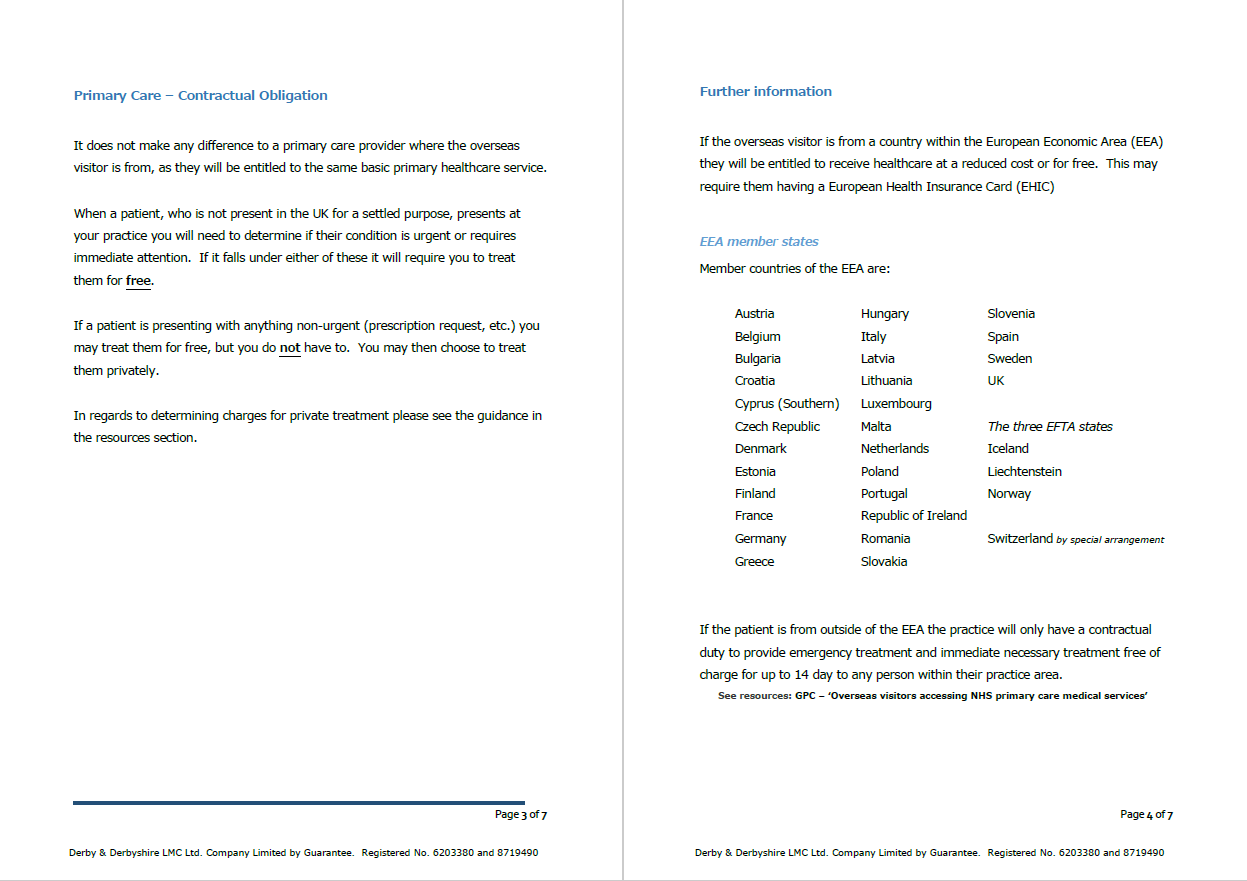
Derby & Derbyshire LMC guidance from August 2014 on charging overseas visitors, demonstrating how much the re-interpretation from the BMA has affected the practicalities of providing care for non-UK residents. Source: Derby & Derbyshire LMC
Derby & Derbyshire LMC guidance from August 2014 on charging overseas visitors, demonstrating how much the re-interpretation from the BMA has affected the practicalities of providing care for non-UK residents. Source: Derby & Derbyshire LMC 

Up until now, the general consensus among GPs seems to have been that it was up to the discretion of the practice to decide whether or not to charge for treatment of anything non-urgent to overseas visitors. A Derby & Derbyshire LMC guidance pamphlet on ‘Overseas Visitors’ from August 2014 also makes clear that any patient from outside of the EEA (European Economic Area) was only entitled to emergency treatment and immediate necessary treatment free of charge for up to 14 days. Under the new guidance however, anyone, ‘regardless of nationality and residential status may register and consult with a GP without charge’. 

The rewording of the guidelines has, despite the BMA’s assurances, completely changed their practical effect. One of the most worrying potential effects is to increase health tourism to the UK. This could potentially lead to yet another drain on the NHS’s dwindling financial resources, as people from outside of the EEA will effectively be paying nothing in the way of taxes or health insurance for the services provided. There are already procedures in effect to make sure that anyone in urgent need of healthcare, regardless of where they are from, will be able to get it through the NHS.

The Department of Health have taken something of a Schrödinger’s Cat approach to this. In April this year they launched a scheme in which patients without an EHIC (European Health Insurance Card) will be charged 150% of tariff pricing for secondary care in an effort to combat health tourism and retrieve £500m per year by 2017.

In response to this particular issue however, they have said that ‘international visitors are welcome to use the NHS provided they pay for it- just as families in the UK do through their taxes’, while also saying that they have a ‘long standing commitment not to charge patients directly for GP or nurse consultations’. The reason being, according to a Department of Health spokesperson, that keeping these services free is in the public interest as someone with a serious infectious illness like TB or Ebola might be ‘deterred from seeking treatment because they fear being charged’.

One can’t help but think that if a patient had Ebola (a horrific disease infamous for its tendency to cause bleeding from every orifice) that it would classify as emergency care requiring urgent treatment, and the patient probably wouldn’t be thinking of calmly booking an appointment with their GP, nor would they be tremendously worried about any sort of ‘charges’.

It should be noted that there are procedures in place to protect the vulnerable in the UK; asylum seekers and refugees are already entitled to treatment. Another overseas visitors guidance document produced by the GPC from May 2005 said that in the event that a patient is not eligible for free treatment and is unable to pay privately, they should be referred to The Refugee Council for assistance. It also notes a resolution passed at the LMC conference in 2004 ‘which opposed proposals to deny failed asylum seekers free primary medical services’.

It seems somewhat apparent, then, that all the bases for vulnerable non-UK and -EU residents seeking NHS treatment were already covered. This makes the new reinterpretations of the guidelines all the more perplexing.

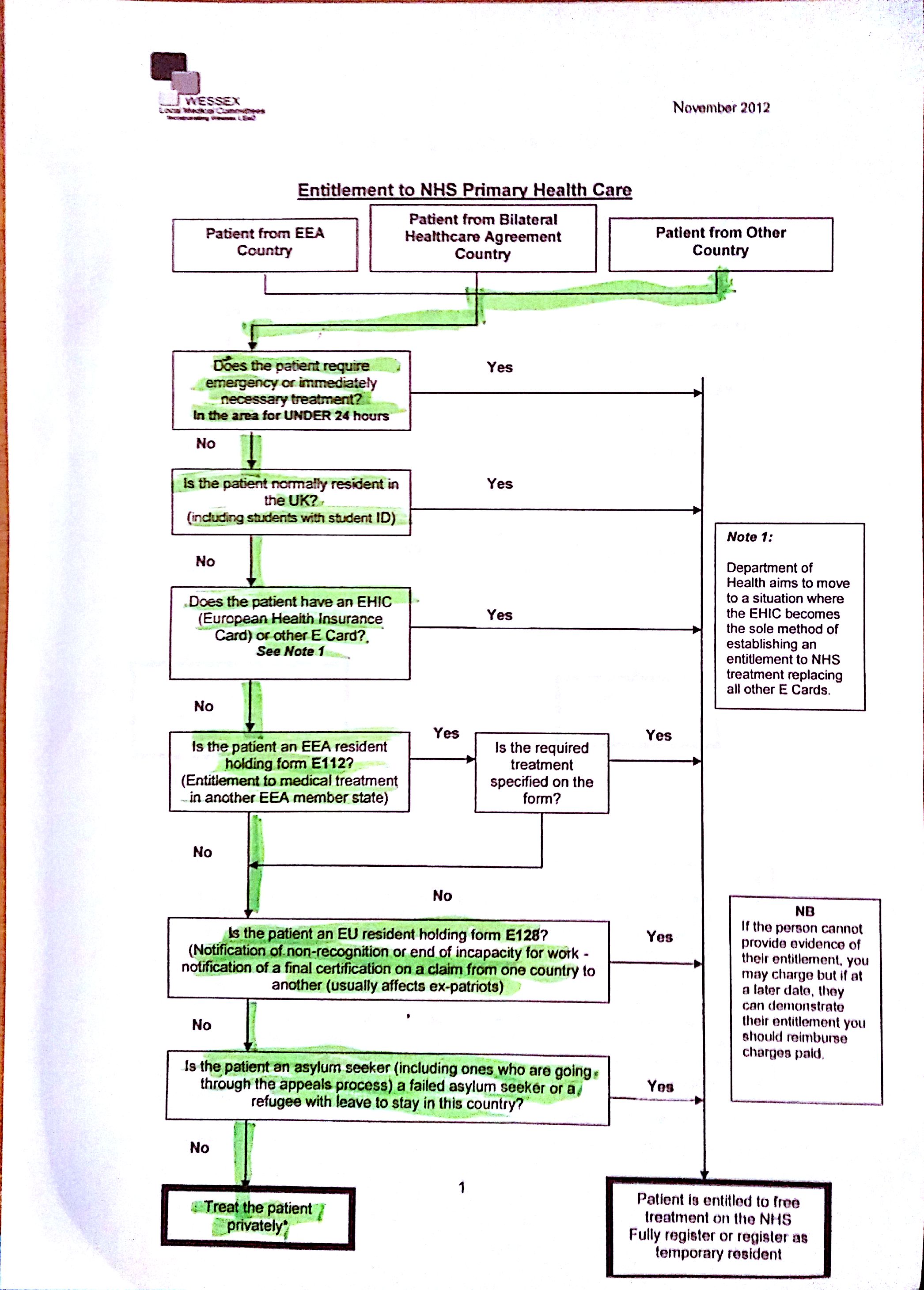
A flowchart distributed by Wessex LMC in November 2012 indicates that previously, primary care would be delivered privately, unless the patient was 'residing in the country for 3 months or more for a settled purpose'. Source: Wessex LMC
A flowchart distributed by Wessex LMC in November 2012 indicates that previously, primary care for non-UK residents outside of a particular set of circumstances would be delivered privately, unless the patient was ‘residing in the country for 3 months or more for a settled purpose’. Source: Wessex LMC

Already, the waiting times to see a GP have risen to 10 days, and are expected to rise to two weeks by next year. GP practices are facing a severe recruitment crisis, leaving GPs overworked and overstressed. Encouraging health tourists with the lure of free consultations will hardly help the matter; it doesn’t take a genius to figure out that a stressed doctor trying to get through a mountain of work is more likely to make mistakes which would be more costly to the general public than some nebulous fear peddled by the Department of Health about “Trojan horse” non-UK residents.

The NHS is not a charity. It is a taxpayer-funded health service. The money to treat patients doesn’t condense from the air like droplets in a glass bottle; it has to be trickled in from the general public and (theoretically at least) responsibly distributed to where it is needed. EEA residents also fund our NHS when they need treatment, through medical insurance cards and their own taxpayer’s money. In addition to this,  a survey conducted by PULSE shows that 77% of GPs support the government’s efforts to stop health tourism by charging foreign visitors for accessing primary care.

These new guidelines leave the NHS wide open to exploitation from health tourists seeking a cheap diagnosis and course of treatment. Dr Zishyan Syed, a GP in Kent, has said:

It is a sad reality but there is abuse of the NHS by foreign visitors. It is only fair that they pay upfront if they are not entitled to free care on the NHS. The NHS is in trouble and it is only right that the Government stops anyone from taking advantage of a system that is already under immense pressure.

Source: PULSE

It would be wonderful if the NHS could treat everyone in the world for free, but the realpolitik of the situation is that they cannot afford to. At this time, it is somewhat reckless for the BMA to reinterpret the guidelines in this way; although they are just following Government regulation. It is more damning that this has been done in the name of the Department of Health

Amendments: Title and other elements have been amended to more accurately reflect the story.

NHS England have since made contact. Their spokesperson has said:

There’s various things going on that have perhaps caused a bit of confusion. DH are looking into guidance around charging people from abroad.

All that we’re doing is just reconfirming the existing guidance around registration for patients. There has been a bit of confusion in some practices about asking for documents to prove that they were local or ordinarily resident, which isn’t required for primary care.

So we’re just reiterating new guidance, there’s nothing new in there.

There is a lot of confusion with word also going around that DH is considering charging for secondary or hospital treatment.

Source: NHS England

There is to be a Department of Health consultation regarding charging overseas visitors later this year.